Chiti arvind
Ph.D. Student
|
RESEARCH INTERESTS
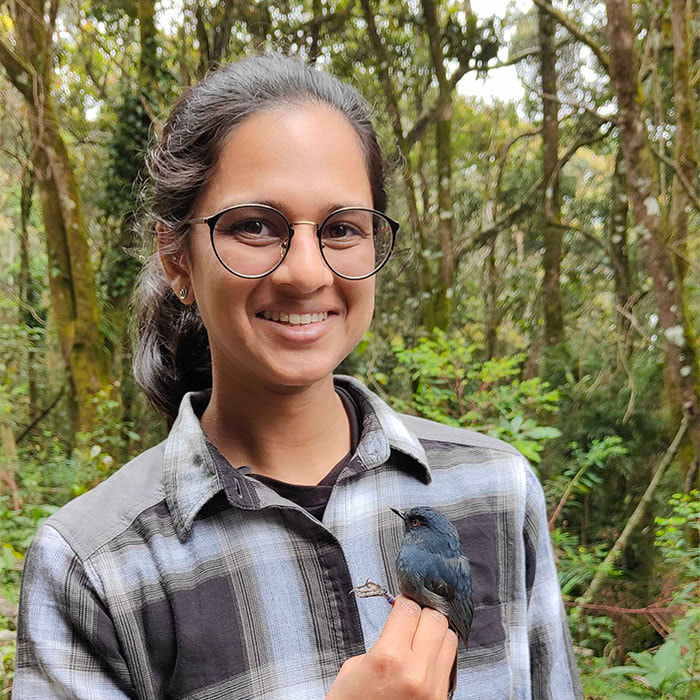
My research focus lies in behavioral ecology and evolutionary biology, especially pertaining to avian vocal signaling. This stems from my previous summer projects (via the POBE program at JNCASR, Bangalore and Khorana Scholars Program at the Smithsonian Tropical Research Institute, Panama). On completing my Masters' thesis on - the evolution of birdsong complexity in suboscine Passeriformes, at Imperial College London , I joined the Bird Lab at IISER Tirupati to continue my research in the field of bioacoustics. As Prime Minister’s Research Fellow, for my PhD, I am examining cultural dialects in songs of the White-bellied Sholakili (WBS), a bird endemic to the Shola Sky Islands of the Western Ghats. What is interesting is the high complexity of this bird’s repertoire, which we quantified with a newly devised metric that uses spectrogram cross-correlation. I’m also investigating whether there is any relation between population-level song dialects and genetic connectivity along this species' distribution gradient. Further, I plan to look at behavioural responses to different dialects and individual-level benefits of having highly complex songs. Among other research projects, I co-wrote a National Geographic grant for a project titled - Testing Anthropause in Soundscapes of Natural and urban habitats across India's Cities. Through this, we aim to examine the effect of anthropogenic noise on the natural soundscapes across seven Indian cities using Automated Recording Units. Previously, I was awarded the Wildlife Conservation Trust Small Grant to create a detection framework using passive acoustic recorders to detect the critically endangered Jerdon’s courser, a bird endemic to the foothills of the Eastern Ghats in Andhra Pradesh. More on my journey into the field of ornithology and ongoing research is featured here (ornithology.in, The Kodai Chronicle, BBC Sounds podcast). Apart from my research, I have been involved teaching assistantships both online (3x - Wildlife Ecology & Basics in Ornithology) ) and offline (3x), as well as managed our long-term field station at Kodaikanal for our summer internship program. I also like to write popular science articles (Research Matters) and interact with young students while engaging them with the ongoing research in my field (Teach For India - Mumbai via WonderGirls). Projects Involved: Sholakili Song Diversity, Jerdon's Courser, Avian Malaria PERSONAL AND OTHER INTERESTS
I love to backpack, explore uncommon places and try out new cuisines (it's always all about the food). When not on the move, one can find me experimenting in the kitchen, primarily baking, which relies more on intuition rather than measures. I also enjoy maintaining (try to!) a green space at home! 
|
| |||||||||


PUBLICATIONS
RESEARCH ARTICLES
RESEARCH ARTICLES
- Sawant, S,. Arvind, C., Joshi, V., Robin, V.V (2022) Spectrogram cross-correlation can be used to measure the complexity of bird vocalizations. BioRxiv. https://doi.org/10.1101/2021.03.30.437665
- Sarangi M, Ganguly P, Zenia, Arvind C, Lakshman A, Vidya TNC. 2014. Common Myna roosts are not recruitment centers. PloS One 9: e103406. http://dx.doi.org/10.1371/journal.pone.0103406